 HAOCOOL

What are the preservation techniques for vegetable cold storage?
After harvest, vegetables continue to respire and lose moisture through evaporation. If post-harvest temperatures are high, ventilation is inadequate, or humidity is poorly controlled, issues such as dehydration (wilting), quality deterioration, and rotting can easily occur. Vegetable cold storage preservation techniques primarily function by controlling temperature, relative humidity, airflow, and the storage environment; this slows down post-harvest physiological changes and creates favorable conditions for inventory turnover and staggered market supply.
It is important to note that different vegetables have varying tolerances for low temperatures. Leafy greens, root vegetables, solanaceous crops (like tomatoes and peppers), cucurbits (like melons and squash), and alliums (like onions and garlic) cannot simply be stored using the same temperature and humidity parameters. Before constructing a vegetable preservation cold storage facility, one must determine the specific vegetable varieties, their condition upon entry, the intended storage duration, and daily intake/dispatch volumes.
1. Simple Storage at the Source
Simple storage at the source relies primarily on local ambient temperatures, diurnal temperature fluctuations, and natural ventilation for preservation. Common methods include cellar storage, pile storage, trench storage, and ventilated warehouse storage.
These methods require relatively low investment in facilities and are suitable for storage-tolerant vegetables such as potatoes, onions, garlic, and pumpkins. However, internal temperature and humidity are susceptible to external weather conditions and are difficult to maintain stably over the long term; thus, these methods are generally better suited for short-term turnover or seasonal storage.
When utilizing natural ventilation, air inlets, exhaust vents, and cargo aisles should be strategically arranged to avoid overcrowding the vegetable stacks. If ventilation within the stacks is insufficient, respiratory heat and moisture cannot easily escape, potentially leading to localized areas of high temperature and high humidity.
2. Mechanical Cold Storage
Mechanical cold storage is a common method for preserving vegetables. Through the use of refrigeration units, air coolers, insulated storage structures, and control systems, the facility maintains the internal temperature within a relatively stable range, thereby reducing the vegetables' respiration rate and moisture loss.
In mechanical cold storage, a lower temperature is not necessarily better. Some cold-tolerant vegetables can be stored in environments approaching 0°C, whereas vegetables sensitive to low temperatures—such as cucumbers, eggplants, and bell peppers—require relatively higher storage temperatures. Setting the temperature too low can lead to chilling injury, manifesting as surface pitting, discoloration, softening, or accelerated decay.
Therefore, the temperature in vegetable cold storage facilities should be determined based on factors such as vegetable variety, maturity, origin, and storage duration; applying a uniform set of parameters across the board is inappropriate.
3. Pre-cooling before storage
Freshly harvested vegetables often retain significant "field heat." If large quantities are moved directly into cold storage without pre-cooling, the cooling load increases rapidly, causing the storage temperature to drop slowly and potentially affecting vegetables already in storage.
Pre-cooling refers to the process of rapidly lowering the temperature of the vegetables themselves prior to sorting, packaging, storage, or transport. Common methods include cold room pre-cooling, forced-air pre-cooling, hydro-cooling (chilled water), and vacuum pre-cooling.
Different methods are suitable for different types of vegetables. Leafy greens require rapid pre-cooling; forced-air or vacuum pre-cooling may be considered depending on product characteristics. Root vegetables and certain storage-hardy varieties can be pre-cooled in the cold room itself, depending on turnover times. The decision to install a dedicated pre-cooling room depends on the volume of produce entering at one time, the initial temperature, and the required cooling timeframe.
4. Humidity control and moisture loss prevention
Most fresh vegetables have high water content; if relative humidity is too low during storage, they are prone to wilting, weight loss, and a decline in eating quality. Consequently, many vegetable cold storage facilities need to maintain high relative humidity levels.
However, higher humidity is not always better. Prolonged condensation within the facility can lead to water droplets forming on vegetable surfaces, packaging, and the structure itself, thereby increasing the risk of decay. In actual operation, comprehensive adjustments are required, taking into account factors such as evaporator temperature difference, airflow velocity, defrosting methods, drainage systems, and humidification equipment. Vegetables such as onions and garlic have humidity requirements that differ significantly from those of leafy greens; therefore, they should not be stored for extended periods in the same cold storage room as vegetables requiring high humidity.
5. Airflow Distribution and Cargo Stacking
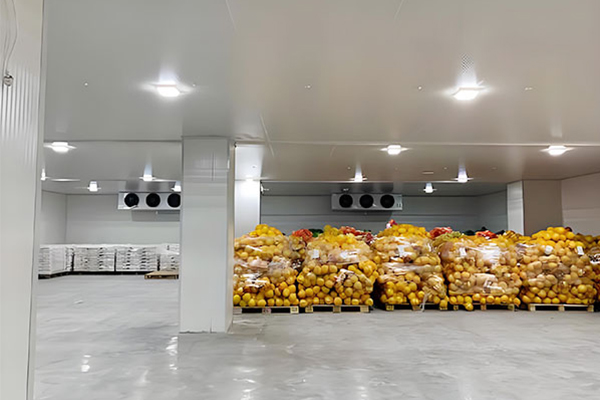
Unimpeded air circulation within the cold storage room is essential to minimize temperature differences across different zones. Stacking cargo directly against air coolers, walls, or the ceiling can lead to issues such as localized over-cooling, dehydration (windburn), or uneven cooling.
When stacking vegetables, return-air channels must be maintained, taking into account packaging dimensions, pallet specifications, and the airflow direction of the air coolers. Adequate clearance should be kept between the cargo and the walls, ceiling, and air coolers, while ensuring that supply and return air vents remain unobstructed.
Air cooler selection must balance heat exchange capacity with airflow velocity. For leafy vegetables prone to moisture loss, direct, prolonged exposure to the airflow from the cooler should be avoided.
6. Low-Temperature Storage Near Freezing Point
Certain cold-tolerant vegetables can be stored at temperatures close to their freezing point without actually freezing. This method further reduces respiration rates but places high demands on temperature control precision, uniformity within the storage room, and monitoring systems.
Significant temperature fluctuations or inaccurate determination of the product's freezing point can result in localized freeze injury. Consequently, near-freezing storage is not suitable for all vegetables; operating parameters should be determined based on specific varieties and experimental data.
7. Controlled Atmosphere (CA) Storage
Controlled atmosphere (CA) storage builds upon standard low-temperature preservation by regulating oxygen and carbon dioxide concentrations within the storage room, thereby slowing vegetable respiration and ripening processes.
CA storage facilities require high standards for airtightness, gas regulation equipment, pressure equalization devices, and monitoring systems. Different vegetables have varying tolerances for oxygen and carbon dioxide levels; improper parameter settings can lead to off-flavors, tissue damage, or anaerobic respiration. Therefore, controlled atmosphere (CA) technology should serve as a supplement to temperature and humidity management rather than a substitute for basic cold storage conditions. For projects involving long storage periods, high-value products, or strict quality requirements, the adoption of a CA strategy can be evaluated based on the specific vegetable variety.
8. Modified Atmosphere Packaging (MAP) for Preservation
Modified Atmosphere Packaging (MAP) typically employs films with specific gas permeability characteristics to regulate the internal levels of oxygen, carbon dioxide, and moisture.
Passive MAP relies primarily on the vegetable's natural respiration and the permeability of the packaging material to establish a relatively stable gas environment, whereas active MAP involves injecting specific gas mixtures into the package based on the product's characteristics.
Packaging materials must be matched to the vegetable's respiration rate, storage temperature, and package weight. Excessively low film permeability can lead to hypoxia (oxygen deprivation), while excessively high permeability makes it difficult to achieve the desired gas composition. Consequently, MAP is generally used in conjunction with low-temperature cold storage.
9. Avoid Indiscriminate Mixed Storage of Vegetables
Different vegetables vary in their sensitivity to temperature, humidity, ethylene, and odors. Even if two types of vegetables share similar storage temperature requirements, they may not be suitable for long-term storage in the same facility.
For instance, leafy vegetables requiring high humidity should not be stored for extended periods alongside onions or garlic, which prefer lower humidity levels; similarly, vegetables sensitive to ethylene should not be stored with produce that emits high levels of ethylene.
For cold chain logistics operations handling a wide range of products, distinct temperature zones can be established based on temperature and humidity requirements as well as product compatibility. Additionally, buffer zones or vestibules can be utilized to minimize temperature fluctuations caused by opening doors. 10. Key Design Points for Vegetable Preservation Cold Storage
Designing a cold storage facility for vegetable preservation requires more than just selecting equipment based on floor area; the following factors must also be comprehensively considered:
Specific vegetable varieties and packaging formats;
Batch intake volume, daily throughput (inbound/outbound), and initial product temperature upon entry;
Inclusion of a dedicated pre-cooling room;
Storage method: floor stacking, racking, or palletization;
Cold storage door dimensions, frequency of opening, and loading/unloading duration;
Target temperature, relative humidity, and storage duration;
Local summer ambient temperatures and condensing conditions;
Requirements for defrosting, humidification, drainage, and temperature monitoring.
During operation, regular inspections should be conducted on temperature probes, evaporator frost accumulation, condenser heat dissipation, drainage lines, and door seals, while also recording fluctuations in internal temperature and humidity. Proper zoning, timely pre-cooling, and standardized stacking help minimize temperature fluctuations and localized temperature gradients.
Vegetable preservation cold storage is not merely about lowering the internal temperature; it requires integrated control of temperature, humidity, airflow patterns, and atmospheric composition based on vegetable variety, post-harvest condition, initial temperature, storage duration, and packaging method. Leafy greens, root vegetables, solanaceous crops (e.g., tomatoes, peppers), and alliums (e.g., onions, garlic) have different storage requirements and should not be stored together in the same temperature zone for extended periods.
Prior to construction, the refrigeration load should be determined based on daily throughput, batch intake volume, pre-cooling needs, stacking methods, door-opening frequency, and local environmental conditions. Additionally, the layout should reasonably incorporate pre-cooling, preservation, sorting, and loading/unloading buffer zones. Haoshuang Refrigeration can configure temperature zones, structural design, refrigeration equipment, humidification and drainage systems, and intelligent control methods tailored to specific project requirements; actual storage parameters should be determined based on the vegetable varieties and operational conditions.
FAqS
Common techniques include temperature control, humidity management, proper ventilation, air circulation, and controlled atmosphere storage to maintain vegetable freshness and reduce spoilage.
The suitable storage temperature depends on the type of vegetable. Most vegetables are stored between 0°C and 10°C with appropriate humidity control.
Proper humidity levels help reduce water loss, prevent dehydration, maintain texture, and extend the shelf life of fresh vegetables.