 HAOCOOL

Semiconductor Cold Storage Construction Plan and Key Points for Temperature and Humidity Control
Semiconductor cold storage differs significantly from ordinary food cold storage in design requirements. Such cold storage not only needs to achieve the set temperature but also requires control over temperature fluctuations, air humidity, cleanliness, static electricity risks, and the continuous operation capability of equipment. Wafer materials, electronic chemicals, packaging auxiliaries, and precision components are highly sensitive to the storage environment. Therefore, before project design, the characteristics of the materials and storage requirements should be confirmed first, followed by the determination of temperature zone division, equipment configuration, and control methods.
1. Clarify Storage Materials and Temperature Zone Requirements
Different semiconductor materials have significantly different storage conditions; equipment selection cannot be based solely on "refrigeration" or "freezing." Some electronic adhesives, packaging auxiliaries, and photolithography-related materials require storage in low-temperature environments, while some precision components place greater emphasis on constant temperature, moisture protection, and condensation prevention.
Before project implementation, the following information should be compiled: material name, packaging form, single storage quantity, daily inflow and outflow quantity, entry temperature, target storage temperature, and allowable fluctuation range. Simultaneously, material safety data and compatibility requirements should be verified. Independent storage areas should be designated based on material properties, cleanliness levels, and risk categories to avoid mixing volatile substances and ordinary packaging materials with materials requiring high cleanliness.
For materials with significantly different storage conditions, a unified set of temperature and humidity parameters should not be used for management. If necessary, different temperature zones, independent buffer rooms, or zoned refrigeration systems can be set up to reduce mutual influence between materials.
2. Effective Temperature, Humidity, and Dew Point Control
Precision industrial cold storage requires strict control of internal temperature differences and short-term temperature fluctuations. Refrigeration load calculations should consider heat transfer from the enclosure structure, as well as heat generated from goods cooling, door opening for ventilation, personnel operations, lighting, equipment dissipation, and defrosting processes.
When selecting equipment, multi-stage capacity regulation, frequency conversion control, or multi-unit联动 (interlocking) operation should be adopted according to load changes to reduce temperature fluctuations caused by frequent compressor start-stops. For storage areas with high temperature stability requirements, start-stop temperature differences and operating logic should be reasonably set to avoid excessively large control ranges.
For humidity-sensitive materials, dehumidification design should consider both the permissible humidity range and dew point temperature. Controlling relative humidity without considering the dew point may lead to condensation at doors, wall panel joints, air vents, or material surfaces.
For areas with frequent door openings or significant temperature differences between the inside and outside of the warehouse, buffer rooms, high-speed doors, air curtains, or dehumidification equipment can be installed to reduce the entry of warm, humid air from the outside, thus lowering the risks of condensation, frost, and temperature fluctuations.
3. Controlling Cleanliness and Static Electricity Risks
When stored materials are sensitive to particulate matter, the walls, ceiling, and floor of the warehouse should be made of smooth, easy-to-clean materials that do not easily accumulate dust. Sealing of insulation board joints, pipe penetrations, door frames, and equipment foundations should be ensured to prevent dust, moisture, and outside air from entering.
Depending on material and production process requirements, anti-static flooring, equipotential bonding, and grounding systems can be installed inside the warehouse. Shelves, handling equipment, and related metal components should also be grounded as needed to reduce the impact of static electricity buildup on precision components.
Cleanliness, anti-static ratings, and grounding methods cannot be determined solely based on cold storage temperature; they should be designed in conjunction with material packaging, handling methods, operational processes, and project technological requirements.
4. Optimize Airflow Within the Storage Area
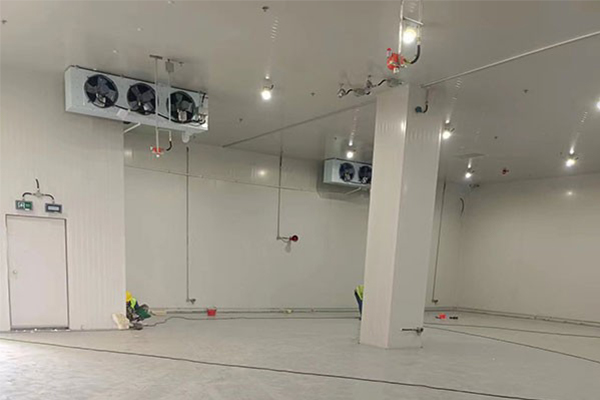
The arrangement of air coolers directly affects temperature uniformity within the storage area. Airflow should not be directed directly at precision materials or packaging surfaces for extended periods to avoid localized excessively low temperatures, condensation on packaging, or changes in material properties.
When arranging shelves, air supply and return channels should be reserved to prevent goods from obstructing return air vents. Dead airflow areas are prone to form at the top, corners, doorways, and areas with dense shelving; these should be adjusted by adjusting fan positions, supply distances, return air paths, and shelf spacing.
For projects with long storage areas, high shelves, or high temperature uniformity requirements, multiple air coolers can be used for zoned air supply, and temperature testing should be conducted to confirm that the temperature difference between different areas meets storage requirements.
5. Configure Backup Equipment and Alarm Systems
The storage of semiconductor materials and precision materials requires high continuous operation capabilities from the equipment. During project design, the need for backup refrigeration equipment should be determined based on the value of materials stored in the warehouse, the allowable temperature fluctuation range, equipment maintenance time, and downtime risk.
For warehouse areas where prolonged downtime is not permitted, a "one-in-one-out" configuration can be adopted, meaning one set of equipment operates normally while the other serves as a backup. When the main compressor, air cooler, or refrigeration unit fails, the backup equipment can be activated, reducing the risk of a continuous rise in warehouse temperature.
The backup equipment should be capable of independent operation and equipped with functions for periodic rotation, automatic switching, or manual switching to prevent the backup unit from failing to start after prolonged downtime. When multiple compressors are used in parallel, capacity regulation equipment and backup equipment should be distinguished; the system's backup capability should not be judged solely by the number of units.
The control system should be equipped with alarms for high temperature, low temperature, humidity anomalies, sensor malfunctions, compressor malfunctions, air cooler malfunctions, and power outages. For warehouse areas with high storage requirements, remote monitoring and anomaly alerts can also be implemented to facilitate timely handling of equipment malfunctions by management personnel.
6. Focus on the Safety of Electronic Chemical Storage
When dealing with electronic chemicals, in addition to temperature and humidity control, the flammability, corrosiveness, volatility, and reactivity of the materials should be verified. Chemicals of different properties should not be stored together without a safety assessment.
The project design should rationally set up daily ventilation, explosion-proof electrical systems, leak monitoring, and emergency exhaust systems based on material safety data, storage quantities, and local regulations. For storage areas that may generate corrosive gases or volatile substances, equipment and pipeline materials should also have corresponding corrosion resistance properties.
Fire protection zones, exhaust methods, electrical ratings, and alarm systems should be designed by qualified units in accordance with the requirements of the project location.
7. Construction Acceptance and Operation Management
After the project is completed, the insulation board joints, door seals, pipeline penetrations, floor joints, and drainage system should be inspected to confirm that the sealing and insulation construction meet the design requirements.
During the system commissioning phase, no-load cooling, load operation, temperature uniformity testing, humidity testing, and alarm linkage verification should be conducted. Temperature sensors should not only be installed at the return air vents of evaporative coolers, but also at monitoring points near the warehouse doors, at different heights on shelves, and in locations where hot zones may form.
For warehouse areas with high temperature and humidity requirements, continuous testing using multi-point recording methods can be employed to observe temperature and humidity changes during door opening, receiving of goods, defrosting, and equipment switching.
After project delivery, records should be established for sensor calibration, equipment inspection, defrosting management, door opening management, filter cleaning, and handling of abnormalities. Regular inspections and data analysis should be conducted to promptly identify issues such as temperature deviations, abnormal humidity, condensation, and equipment instability.
The construction of semiconductor cold storage requires a comprehensive environmental control plan based on the characteristics of the materials. The project design must not only meet the target temperature zone but also comprehensively consider humidity, dew point, cleanliness, anti-static properties, airflow organization, equipment redundancy, and safety management. Only through coordination in design, construction, commissioning, and operation management can the impact of environmental fluctuations on the storage of precision materials and production processes be minimized.
FAqS
Precise temperature and humidity control helps protect semiconductor materials, prevent condensation, reduce contamination risks, and maintain stable production and storage conditions.
The design should consider temperature accuracy, humidity control, air cleanliness, airflow organization, insulation performance, refrigeration reliability, and monitoring systems.
Semiconductor cold storage usually requires reliable refrigeration systems with accurate control, stable operation, and continuous monitoring, including precision cooling equipment and automated temperature and humidity management systems.