 HAOCOOL

How to Choose an Overseas Cold Storage Engineering Company?
As food processing, fruit and vegetable preservation, seafood freezing, meat storage, and cold chain logistics projects continue to expand overseas, more and more companies need to build cold storage warehouses, frozen warehouses, blast freezers, or large-scale logistics cold storage facilities abroad. Compared to domestic projects, overseas cold storage involves not only refrigeration equipment and insulated storage structures, but also considerations such as local climate, power standards, transportation and customs clearance, installation organization, and after-sales service. So, how to choose an overseas cold storage engineering company? It is recommended to make a comprehensive judgment based on the following aspects:
1. First, clarify the actual needs of the cold storage project
Before selecting a cold storage engineering company, the project owner should first compile basic parameters, including the country and city where the project is located, the length, width, and height of the cold storage, the products to be stored, the incoming temperature, the target storage temperature, the daily incoming volume, the freezing time, and the local voltage and frequency.
For example, the requirements for equipment configuration are different for ordinary fruit and vegetable preservation warehouses, meat freezing warehouses, and food blast freezers. If the initial parameters are incomplete, it will be difficult for the engineering company to accurately calculate the cold load, which may lead to adjustments in equipment or increased costs later.
2. Assess Overseas Project Experience
Overseas cold storage projects are significantly affected by local environments and construction conditions. When selecting an engineering company, check if they have completed projects in similar countries, climate zones, or usage scenarios.
Project case studies should not be judged solely by on-site photos. Attention should also be paid to the cold storage scale, design temperature, stored products, equipment configuration, and operational status. For high-temperature regions, frigid regions, high-altitude regions, or coastal areas, condensers, compressors, electrical control systems, and insulation structures may require specific designs.
Simultaneously, it's crucial to understand whether the engineering company possesses experience in equipment export, cross-border transportation, customs clearance coordination, on-site installation, and commissioning. Overseas projects involve numerous delivery stages, making project management capabilities just as important as equipment quality.
3. Determine the Rationality of the Cold Storage Design
Cold storage equipment selection cannot be based solely on area or volume. A comprehensive cooling load calculation typically considers factors such as heat transfer within the storage structure, product arrival heat, door ventilation, lighting, personnel heat dissipation, equipment operating time, and outdoor ambient temperature. For blast freezers, it's crucial to carefully calculate single-batch delivery volume, initial product temperature, freezing time, and delivery schedule. Insufficient refrigeration capacity may result in slow cooling and products failing to reach required core temperatures; excessive capacity may increase equipment investment and operating energy consumption.
Project owners should request engineering companies to explain the selection criteria for compressors, condensers, air coolers, refrigerants, and defrosting methods, rather than simply providing equipment models and total prices.
4. Confirm Equipment Suitability for Local Conditions
Electricity standards, ambient temperatures, refrigerant supply, and maintenance conditions vary across countries and regions. Overseas cold storage solutions should confirm equipment voltage and frequency compatibility, electrical component compatibility with local power supply conditions, and the ease of refrigerant procurement and replenishment.
In regions with high summer temperatures, it's necessary to verify if the condenser has sufficient heat exchange capacity; in cold winter regions, low-temperature operation control, drainage freeze protection, and pipe insulation must be considered.
If the project is located far away, priority should be given to readily available and maintainable locally sourced spare parts, and a list of easily damaged parts should be prepared to minimize downtime in case of equipment failure.
5. Carefully Verify the Scope of the Quotation
When comparing quotations for overseas cold storage projects, don't just look at the total amount; confirm what's included in the quote. This typically requires separately verifying items such as insulated panels, cold storage doors, compressor units, condensers, air coolers, electrical control systems, copper pipes, cables, refrigerant, lighting, installation, and commissioning.
Transportation costs, customs clearance fees, taxes, hoisting fees, accommodation and meals for construction personnel, and local auxiliary materials should also be clearly stated in the contract or quotation specifications. Some quotes may appear low but may not include installation, transportation, or refrigeration auxiliary materials, potentially leading to additional expenses later.
The project owner should also confirm the currency of the quote, payment terms, equipment production cycle, transportation cycle, and pricing methods for additional items.
6. Understand the Construction and Delivery Methods
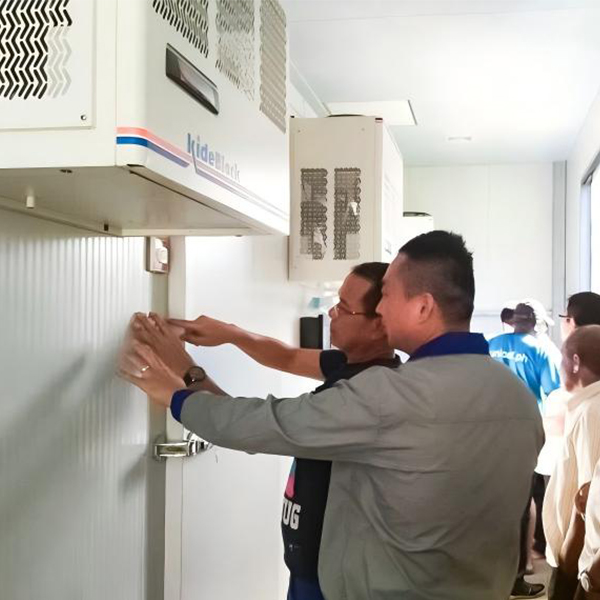
Common delivery methods for overseas cold storage projects include export of complete equipment, on-site installation by domestic technicians, installation by local construction teams with remote guidance, and joint construction with local partners.
For small, standard cold storage facilities, local installation with remote technical support can be chosen based on budget. For large-scale cold storage facilities, including blast freezers, food processing cold storage, and logistics cold storage, it is recommended that an engineering company with project management experience be responsible for installation guidance, system commissioning, and performance testing.
Before construction, it should be clearly defined which party is responsible for the civil engineering foundation, ground insulation, power supply, drainage, equipment hoisting, and machine room conditions to avoid delays due to unclear scope of work.
7. Confirm Acceptance Standards and After-Sales Service
After installation, empty storage cooling, load operation, and continuous operation tests should be conducted according to the contract. Acceptance criteria may include internal temperature, cooling time, temperature uniformity, equipment operating current, defrosting effect, and control system functionality.
Regarding after-sales service, the warranty period, fault response methods, spare parts supply, remote technical support, and on-site service conditions should be clearly defined. The engineering company should also provide equipment manuals, electrical diagrams, piping diagrams, operation training materials, and maintenance recommendations to facilitate subsequent use and maintenance by local personnel.
Choosing an overseas cold storage engineering company requires a comprehensive comparison of their project experience, design capabilities, equipment compatibility, price range, cross-border delivery, construction organization, and after-sales service. Equipment configurations and construction methods will vary depending on the temperature, products, and throughput of the cold storage project.
FAqS
You should evaluate the company’s engineering experience, completed international projects, refrigeration technology capability, installation support, and after-sales service. A reliable supplier should provide complete solutions from design and equipment supply to installation and commissioning.
Overseas experience helps companies understand different climates, local standards, logistics conditions, and installation requirements. Experienced cold storage contractors can provide more suitable refrigeration solutions and reduce project risks.
A professional company should offer complete services including refrigeration design, cooling load calculation, equipment selection, cold room construction, installation guidance, system commissioning, and technical support after project completion.