 HAOCOOL

Meat Thawing Room Temperature: Design & Equipment Guide
Meat tempering and thawing rooms play an important role in meat processing plants, slaughterhouses, and frozen food factories. Proper thawing conditions help maintain meat quality, reduce drip loss, improve processing efficiency, and control microbial growth.
One of the most common questions when designing an industrial meat thawing room is: What temperature should a meat tempering and thawing room maintain?
The answer depends on the type of meat, product size, initial freezing temperature, processing requirements, and the desired final product temperature.
1. What Is the Recommended Temperature for a Meat Thawing Room?
For controlled refrigerated thawing, an air temperature of approximately 0°C to 4°C is a practical starting point for many meat products. The exact operating temperature and thawing duration must be determined through process validation and applicable food safety requirements.
For certain whole carcass thawing applications, the Food and Agriculture Organization (FAO) describes a temperature range of approximately 4°C to 6°C under controlled conditions.
It is important to distinguish between two processes:
Meat thawing: Frozen meat is gradually brought close to its unfrozen state, with the product's thermal center approaching 0°C.
Meat tempering: Frozen meat is partially softened to approximately -5°C to -2°C, making it easier to slice, cut, debone, or process.
Therefore, a meat tempering room and a complete thawing room should not automatically use the same temperature settings.
2. Why Is Temperature Control So Important?
During thawing, the surface of frozen meat warms faster than its center. If the surface temperature becomes too high while the internal meat remains frozen, microorganisms may multiply before the thawing process is complete.
Proper temperature control helps to:
Reduce bacterial growth risks.
Maintain meat texture and color.
Minimize thawing drip loss.
Preserve product quality.
Improve consistency during subsequent processing.
The refrigeration system should maintain stable conditions throughout the entire thawing cycle rather than simply reaching a target room temperature.
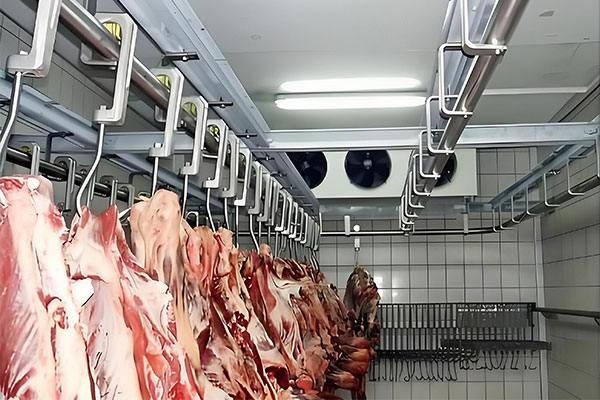
3. What Equipment Is Required for an Industrial Meat Thawing Room?
A professional industrial meat thawing room generally includes several important components:
Industrial refrigeration unit: Provides stable cooling capacity and maintains the required room temperature.
Air coolers and circulation fans: Ensure uniform air distribution and prevent significant temperature differences between different areas.
Temperature and humidity sensors: Monitor environmental conditions and support automatic adjustments.
Automatic control system: Controls compressor operation, fan speed, defrosting cycles, and temperature alarms.
Insulated sandwich panels: PU or PIR insulated panels help reduce heat transfer and improve energy efficiency.
Drainage system: Collects thawing water and meat drip while supporting hygienic operation.
For large meat processing facilities, multiple independent thawing rooms can be designed to accommodate different meat types and production schedules.
4. How to Design an Efficient Meat Tempering and Thawing Room?
The design of a meat thawing room requires more than selecting refrigeration equipment.
First, engineers need to calculate the daily meat processing capacity, the weight of each batch, the initial product temperature, and the required thawing time.
Second, the refrigeration system must be selected according to the actual heat load, room dimensions, product arrangement, and loading frequency.
Third, airflow distribution should be carefully designed. Excessive airflow may increase surface drying and product weight loss, while insufficient airflow can cause uneven thawing.
The room should also have suitable drainage, hygienic surfaces, insulated doors, and reliable temperature monitoring.
5. How Can Energy Efficiency Be Improved?
Energy consumption is an important consideration for large-scale meat processing facilities.
Several measures can improve refrigeration efficiency:
Use high-efficiency industrial refrigeration compressors.
Select appropriately sized evaporators and condensers.
Improve insulation and door sealing.
Minimize unnecessary door opening.
Optimize fan operation and defrost control.
Use automated temperature monitoring.
Arrange production batches to reduce repeated temperature fluctuations.
These measures help improve operating stability and reduce unnecessary energy consumption.
6. Professional Refrigeration Solutions for Meat Processing Plants
A meat tempering and thawing room is an important part of the industrial meat cold chain. Its performance directly affects product quality, processing efficiency, and food safety management.
HAOCOOL provides integrated EPC services for industrial cold storage and refrigeration projects, including engineering design, refrigeration equipment procurement, installation, commissioning, and after-sales service.
For slaughterhouses, meat processing factories, and frozen food facilities, HAOCOOL can develop refrigeration solutions based on processing capacity, product characteristics, temperature requirements, and local operating conditions.
A properly designed meat thawing system combines accurate temperature control, uniform airflow, suitable refrigeration capacity, and hygienic construction to support reliable and efficient meat processing operations.
FAqS
A controlled refrigerated meat thawing room commonly operates at approximately 0°C to 4°C. The actual temperature should be determined by meat type, product size, thawing time, and food safety requirements.
Meat tempering partially softens frozen meat to make cutting and processing easier, while meat thawing brings frozen meat closer to its unfrozen state. Both processes require carefully controlled temperature and airflow.
Typical equipment includes industrial refrigeration compressors, air coolers, circulation fans, temperature and humidity sensors, automatic control systems, insulated sandwich panels, and drainage facilities.