 HAOCOOL

Slaughterhouse Refrigeration Equipment: Types & Selection
Refrigeration systems are essential for modern slaughterhouses. They help maintain meat quality, control bacterial growth, meet food safety requirements, and ensure efficient processing and storage. A properly designed slaughterhouse refrigeration system must support different stages of production, including carcass chilling, meat processing, freezing, and finished product storage.
Choosing the right industrial refrigeration equipment depends on slaughtering capacity, animal species, processing technology, storage requirements, and local food safety regulations. Below are the main types of refrigeration equipment used in slaughterhouses and the key factors to consider when selecting them.
1. Carcass Chilling Rooms
Carcass chilling rooms are among the most important refrigeration facilities in a slaughterhouse. After slaughtering and initial processing, carcasses need to be cooled under controlled conditions to reduce product temperature and maintain meat quality.
Typical equipment includes:
Industrial refrigeration compressors.
Air coolers and evaporators.
Air circulation fans.
Temperature and humidity sensors.
Automatic control systems.
Insulated cold room panels and doors.
The cooling system must provide uniform airflow throughout the room. Poor air distribution may cause uneven cooling, affecting product quality and storage conditions.
The room capacity and refrigeration load should be calculated according to the daily slaughtering volume, carcass weight, incoming product temperature, and required cooling time.
2. Meat Blast Chilling and Freezing Equipment
Some slaughterhouses require rapid chilling or freezing systems to handle large production volumes and meet specific processing requirements.
Common equipment includes:
Blast chillers.
Blast freezing rooms.
High-capacity refrigeration units.
Industrial air coolers.
Automatic temperature monitoring systems.
Blast chilling is designed to reduce product temperature quickly under controlled conditions, while blast freezing is used when products need to be frozen for longer-term storage or transportation.
The equipment selection should consider product size, loading density, required processing time, airflow distribution, and final product temperature.
3. Frozen Meat Storage Rooms
For slaughterhouses supplying frozen meat to domestic or international markets, dedicated freezer warehouses are often necessary.
Typical configurations include:
Low-temperature refrigeration compressors.
Industrial evaporators.
Air-cooled or evaporative condensers.
PU or PIR insulated sandwich panels.
Insulated sliding freezer doors.
Automatic defrost systems.
Temperature monitoring and alarm systems.
The insulation thickness and refrigeration capacity should be determined by the required storage temperature, warehouse dimensions, product turnover, and local ambient conditions.
4. Offal and By-Product Refrigeration Rooms
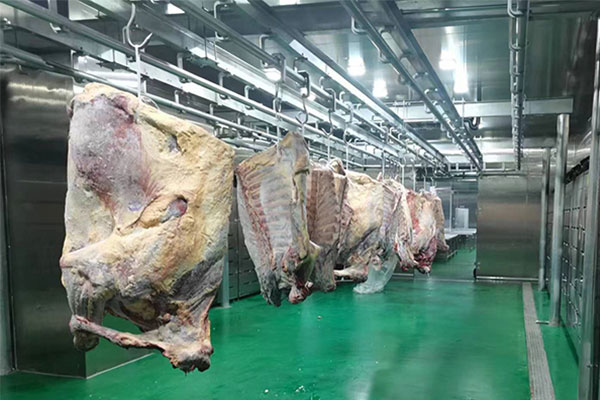
Slaughterhouses also need refrigeration facilities for edible offal and other temperature-sensitive by-products.
Different products may require separate storage areas because their hygiene requirements, processing procedures, and temperature conditions can vary.
A suitable configuration may include independent cold rooms, dedicated evaporators, temperature monitoring equipment, and hygienic insulated doors.
Separating different product categories helps improve hygiene management and reduces the risk of cross-contamination.
5. Industrial Refrigeration Compressors and Condensers
The refrigeration compressor is the core component of an industrial refrigeration system. Common options include reciprocating and screw compressors.
Reciprocating compressors: Suitable for certain small and medium-sized refrigeration applications and systems with appropriate load requirements.
Screw compressors: Commonly used in large industrial refrigeration projects because they can support high cooling capacities and continuous operation.
Condensers are responsible for rejecting heat from the refrigeration system. Common types include air-cooled, water-cooled, and evaporative condensers.
The selection depends on refrigeration capacity, outdoor temperature, water availability, energy consumption, and maintenance requirements.
For large slaughterhouses, centralized refrigeration systems may be considered to coordinate multiple chilling rooms, freezing areas, and storage warehouses.
6. Refrigeration Automation and Temperature Monitoring
Modern slaughterhouse refrigeration systems increasingly use automated control and monitoring technologies.
Important functions include:
Real-time temperature monitoring.
Automatic compressor control.
Evaporator fan and defrost management.
High- and low-pressure protection.
Equipment fault alarms.
Remote monitoring and operating data recording.
These systems help maintain stable storage conditions, reduce unnecessary energy consumption, and improve operational reliability.
7. How to Select the Right Refrigeration System for a Slaughterhouse
Before selecting refrigeration equipment, project owners should evaluate several important factors:
Daily slaughtering capacity and processing throughput.
Animal species and average carcass weight.
Required chilling and freezing capacity.
Number and size of refrigeration rooms.
Product storage temperature and turnover rate.
Local climate and electricity supply.
Hygiene requirements and applicable food safety regulations.
Future production expansion and equipment redundancy.
A professional engineering assessment should calculate the total refrigeration load before determining compressor capacity, condenser specifications, evaporator configuration, and insulation requirements.
Conclusion: Integrated Refrigeration Solutions for Slaughterhouse Projects
A slaughterhouse refrigeration system is not simply a collection of cold rooms. It is an integrated engineering system connecting carcass chilling, meat processing, freezing, storage, ventilation, and automated temperature control.
HAOCOOL provides integrated EPC services for industrial cold storage and refrigeration projects, including project planning, engineering design, refrigeration equipment procurement, installation, commissioning, and after-sales service.
With a comprehensive engineering approach, slaughterhouse owners can develop refrigeration facilities that match their production capacity, improve cold chain efficiency, maintain product quality, and support long-term operational reliability.
FAqS
Common equipment includes industrial refrigeration compressors, condensers, evaporators, carcass chilling rooms, blast freezers, meat storage rooms, insulated panels, and automatic temperature control systems. The configuration depends on slaughtering capacity and processing requirements.
Screw compressors are commonly suitable for large slaughterhouses with high and continuous refrigeration loads. Reciprocating compressors can be suitable for smaller systems or applications with different load requirements. The final selection should be based on refrigeration capacity, operating conditions, energy efficiency, and maintenance costs.
The required temperature depends on the meat type, carcass size, airflow, cooling process, and applicable food safety regulations. Chilling room temperatures and cooling times should be determined through professional process design to ensure safe and uniform carcass cooling.